What Must We Give Up?
We are taught to be realistic about competing ambitions. Faster, better, cheaper: choose what matters and accept what must give. Yet some contradictions depend on assumptions we have mistaken for necessities. Drawing on strategies across living and human systems, biomimetic intelligence investigates how those relationships can change. Several difficult resolutions can converge in one simple uncompromising solution.
How many times have you let go of an ambition because you could see no way to achieve it without sacrificing something else that mattered?
The shareholders want stronger returns. The research team needs another six months. Customers expect services that anticipate their needs without surrendering control of their personal data. The sustainability team has a carbon commitment to deliver, and the next quarterly announcement is already being drafted.
Beyond that room, governments are asked to protect domestic industries and keep prices low. To secure access to foreign markets while reducing dependence on other countries. To build new sources of prosperity using revenues from industries they intend to outgrow. To improve public services while containing taxes and debt. To strengthen national security without deepening the tensions that make people feel unsafe. Each is expected to put its own people first while helping resolve crises no country can contain alone.
Everyone has a reasonable request. Together, they appear to be asking for the impossible.
Most of us know some version of this room. Sometimes it is a boardroom. Sometimes it is a kitchen table. Sometimes the meeting is inside our own head: one goal requires our undivided attention while another conflicting desire keeps reminding us that it matters too.
The tensions extend through the systems we inhabit. We need to concentrate deeply and remain alert to what might require us to change course. A relationship asks us to build a shared life without losing the people who chose it. A parent must protect a child while allowing the independence through which that child learns to navigate danger. An organisation must question the practices on which its present success depends.
Humanity seeks greater material security through activities that can erode its ecological foundations. Even a living cell faces a version of the predicament: its boundary must protect its internal conditions while allowing the exchanges that keep it alive.
The scales change. The competing demands remain familiar.
Eventually, we tell ourselves to be realistic. Which usually means deciding what to give up.
We become skilled at this. We rank priorities, negotiate concessions and distribute disappointment. We call the result balanced. The bargain becomes so familiar that we stop noticing its terms.
This or that.
The word ‘or’ is so small that we rarely question the assumptions that invited it into the sentence.

Who put them in opposite corners?
Speed, quality, cost. Pick two.
Within an established process, the triangle may describe the available choices accurately. Yet tucked inside it is an enormous assumption: that the process itself will stay the same.
A production method that prevents defects can reduce rework, shorten delivery times and lower costs together. The triangle describes the limitations of a particular arrangement. Its authority depends on keeping that arrangement intact.
Consider an investor asked to finance a new power project. The investment needs committed customers. The customers need confidence that the project will be financed and built. Each side appears to need the other to move first.
Committing quickly appears to mean accepting a weaker investment. Waiting for certainty delays the project and adds cost, without necessarily producing the certainty anyone needs.
But must either side commit unconditionally first? Customers can sign purchase agreements subject to financing and other milestones, while lenders make funding conditional on acceptable purchase agreements. The commitments can be coordinated so each helps provide the assurance the other requires.[1]
A different arrangement could shorten the wait, strengthen the investment and reduce the cost of delay. What appeared to demand a sacrifice may have depended on an assumption about the order in which things had to happen.
Before choosing which requirement must lose, ask what put them in opposite corners of the ring.
This was central to the work of Soviet inventor Genrich Altshuller and his collaborator, Soviet engineer and writer Rafik Shapiro, whose early work helped establish TRIZ, the theory of inventive problem solving.[2, 3] They examined invention through contradictions: situations in which improving one characteristic causes another to deteriorate.
Adding material can make a component stronger and heavier. Removing it can make the component lighter and weaker. With only those moves available, the designer must settle between the two ambitions. TRIZ directs attention towards ways of changing the relationship itself: perhaps a different internal structure can provide strength while using less material.
The search then extends beyond the immediate field. A problem encountered in manufacturing may share its underlying structure with one already addressed in another technology or a living system. Their 1956 account included studying approaches in nature and technology, changing the environment and neighbouring systems, and integrating those changes into a functioning whole.[4]
A contradiction becomes a precise description of what the next invention must overcome.
What contradictions conceal
Strategies found across the universe reveal an intelligence expressed through relationships: how structure directs a force, how an organism responds to changing conditions, how an ecosystem circulates resources, how a human invention makes a previously impossible combination work.
Biology, engineering and organisational design divide subjects usefully, but a relationship does not cease to matter when it crosses a departmental boundary.
This is the depth that a superficial reading of biomimetics, or biomimicry, misses. A building given the outline of a leaf may require additional structure and material to achieve the resemblance, becoming more resource intensive. But has the design understood what the leaf’s form accomplishes: how its geometry, internal organisation and surroundings participate in several functions at once?
Copying a silhouette leaves most of that knowledge behind.

A contradiction expressed as two opposing targets may contain different timescales, environments, functions and participants. An apparent conflict can depend on requiring something to behave identically in conditions where different behaviour would serve us better.
Complexity begins to reveal relationships that a simpler description had concealed.
Requirements that looked inseparable from their disadvantages can sometimes be rearranged, distributed or fulfilled through an entirely different mechanism.
The Maltese physician and psychologist Edward de Bono developed lateral thinking to make this movement deliberate: changing the starting perception, introducing a provocation, approaching a familiar problem through an unfamiliar relationship.[5] In his book, Simplicity, he also explores the work of understanding that meaningful simplification requires. A simple description arrived at too soon may erase precisely the relationships through which a resolution could emerge.[6]
How often is a contradiction truly unresolvable, and how often have we exhausted only the ways of seeing it that we already know?
A product that refused the bargain
Mycelium, the branching network through which fungi grow, offers possibilities for making materials from biological resources. Developing dependable building products demands that biology, material science, manufacturing and commercial viability work together.
Materials must perform reliably in buildings where people live and work. Safety and readiness cannot be inferred from an exciting sample.
Biohm had been pioneering this field, developing its first mycelium insulation over approximately seven years and establishing a pilot manufacturing facility in the UK. That experience exposed challenges facing the wider industry: achieving the required combination of properties consistently, at a viable production rate and cost. Readiness for use governed Biohm’s development.
The material needed to insulate effectively and withstand handling. Its structure had to reconcile competing demands for density, strength and porosity. Biological processes had to support dependable manufacturing. Scaling across regions required adaptability to different local resources. Durability during use had to coexist with a route back into material cycles afterwards. Environmental benefits needed to accompany affordability and a credible commercial margin.
In material development, improving one property can actively deteriorate several others. A promising formulation can create a processing problem. A faster process can alter the material it produces. Each adjustment changes the conditions under which other decisions were made.
A list of individually improved parts does not guarantee an improved whole. Sometimes it assembles a new set of problems.
In 2024, biomimetic intelligence was applied to this interlocking challenge, supporting the development of Terraphyll, a high performing insulating material technology by Biohm. Resolutions across the material, production system and intended use were developed together, then tested for what happened when they interacted.
Over approximately six months, a radical evolution of the technology emerged. A subsequent UK patent application was filed in 2025.
Those six months built on seven years of accumulated knowledge, enabling the team to pursue a combination of outcomes previously out of reach.
The experimental process enabled the physical testing of between 400 and 1,000 samples with unique formulations per week, alongside many more computational evaluations. The means of generating knowledge became part of the design challenge, addressing research productivity, speed and resources together.
Biohm reports thermal conductivity of 0.036 W/m.K and an A+ rating for volatile organic compound emissions, alongside its carbon negative profile and adaptability to different agricultural and industrial feedstocks.[7]
Production trials and a costed manufacturing model supported the manufacturing cost and margin targets, with the model projecting commercial viability at scale. Affordability became part of the route to adoption, alongside the performance and environmental case.
A specifier could approach the technology through several priorities and find reasons to consider the same product: insulation performance, cost, recovered resources, indoor air quality, carbon impact. Local inputs opened possibilities for local manufacturing and its associated social value.
At the end of this work sat a simple and humble insulation panel.
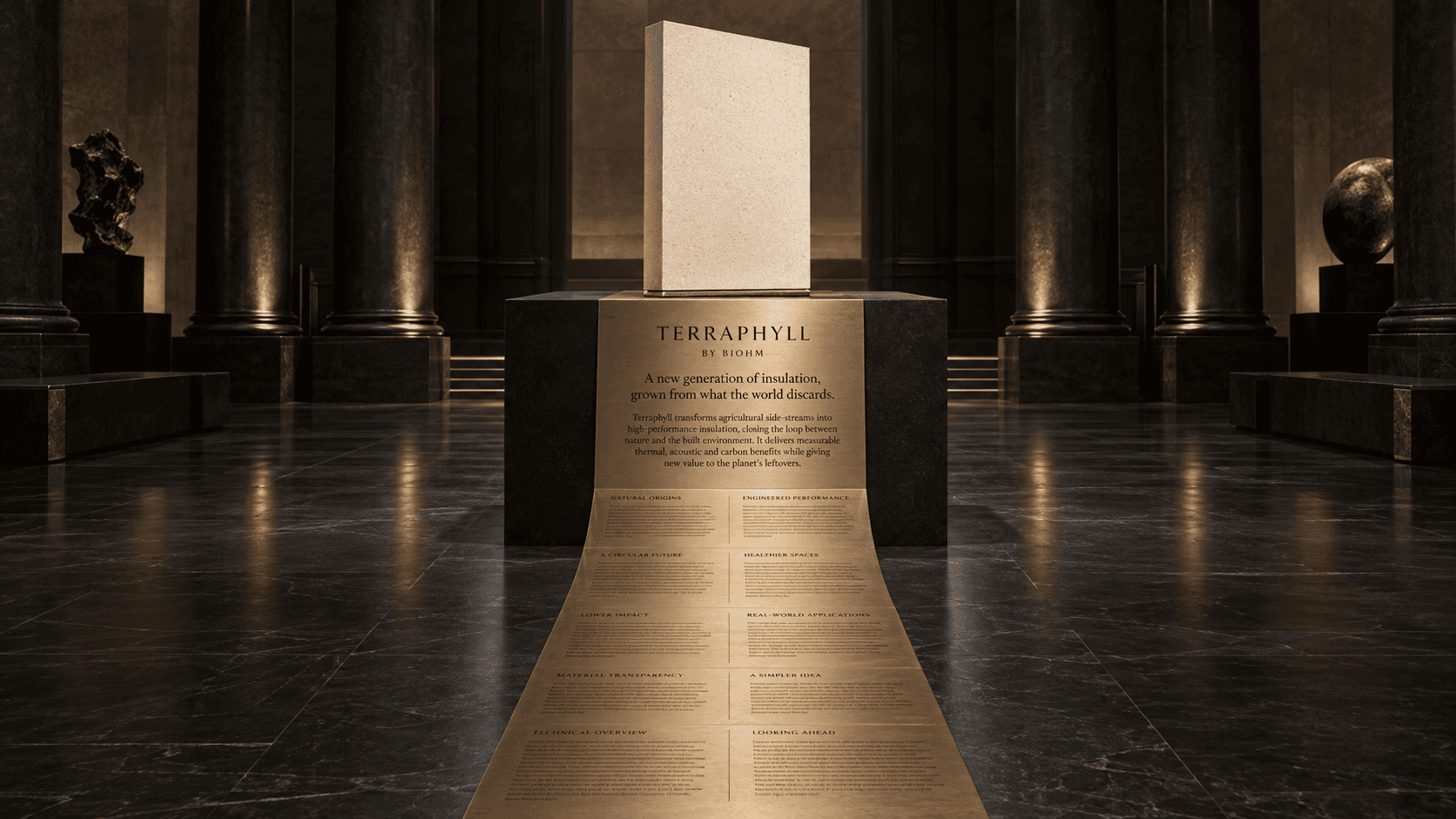
Its ordinary appearance concealed a substantial reorganisation of relationships. The panel was simultaneously a building component, a use for recovered resources and the outcome of a revolutionary approach to production and experimentation.
Here, de Bono’s argument in Simplicity becomes tangible.
The development journey had to enter the complexity, understand it and work through it before several difficult resolutions could become one apparently straightforward thing.
One stone
The same refusal to accept an inherited bargain informed work for FTSE 100 property developer British Land at Regent’s Place in London, UK, delivered through Biohm.
Improving environmental outcomes can appear to mean adding cost and effort to waste management. Yet the resources leaving a property belong to a larger system of purchasing, refurbishment, occupation and maintenance. A disposal problem and a procurement need may sit in separate budgets while containing possibilities for each other.
Resource and stakeholder mapping, interviews, surveys and site visits brought those relationships into view. Laboratory work tested selected resource streams and incorporated them into physical material samples. Wider carbon and commercial benefits were modelled as potential outcomes of implementation.
Reducing disposal while creating something worth procuring required changes in relationships and practices alongside material development.
Separate projects undertaken by Biohm with major healthcare and pharmaceutical organisations explored another difficult conjunction. Materials used to protect health can leave problematic residues and plastics behind. Treating them carries its own costs. Could their treatment also produce something valuable?
The work investigated bioremediation: using biological processes to break down unwanted substances. Selected fungal strains were assessed for their ability to grow on dried egg residues from pharmaceutical research and help break down their hazardous components. Other experiments examined fungal breakdown of plastics in protective equipment. Chemical analyses and other measurements provided promising evidence of breakdown, establishing grounds for larger research programmes.
During treatment, fungi can also produce enzymes and other useful compounds. Biohm describes pharmaceutical applications for such products, including drug discovery and natural antibiotic development.[8]
Further development could investigate suitable compounds for pharmaceutical and food system additives, with each intended use requiring its own evidence of purity, safety and performance. Valuable outputs could help finance treatment and incentivise recovery of resources otherwise destined for burial or burning.
Another boardroom tension concerns productivity and the needs of those expected to deliver it. What if supporting those needs improved organisational performance?
The same biomimetic intelligence methodology that developed Terraphyll for Biohm and explored waste valorisation in construction and healthcare for multinationals addressed that question through a workplace wellbeing concept. An initial focus on indoor air quality expanded to encompass the building, its occupants and their organisation.
A person’s experience of work cannot be reduced to an air quality reading. The physical environment interacts with the demands of a task, opportunities for privacy and collaboration, individual preferences, psychosocial wellbeing and organisational expectations. Improving one measurable condition can leave the central difficulty intact.
The proposed adaptive system brought environmental conditions, human needs and organisational behaviour into the same design. Wellbeing and productive work became outcomes to develop together.[6]
Across these applications, several pressures become requirements for one developing response. Their relationships and contradictions provide fertile ground for innovation.

In the ‘and’
Replacing ‘or’ with ‘and’ asks for a change in how we see and organise the problem. Simply demanding more from the same people, through the same process, leaves the contradiction exactly where it was.
The work is to find the dimension in which the apparent opposition can change. Time, structure, relationships, incentives and the boundary drawn around a problem all affect what seems possible within it.
The decisive test comes when the resolutions meet. A material’s best performance and lowest cost might belong to different formulations. A property fund may offer investors frequent opportunities to withdraw their money while holding buildings that take months to sell.[9] The claimed combination needs an arrangement that can actually support it. Each promise must remain deliverable when the others are honoured.
Each resolution changes the conditions in which the others must work. Their combination can reveal further conflicts, unexpected capabilities and opportunities that none offered alone. The design advances until the relationships between its parts support the ambitions held for the whole.[6]
Because in the ‘and’, we begin to see how fulfilling one requirement could help fulfil another.
The relationships that made our ambitions compete become the means of achieving them together. It is all in the ‘and’.

Implementation reveals new relationships. Scaling introduces pressures a prototype never encountered. Changing needs expose new contradictions. We can keep searching for these tensions deliberately, using them to guide the next evolution before they harden into accepted compromises.
The best solutions tend to be the ones that simply do not compromise. They also allow the complexity of this uncompromising design journey to disappear into something seamless. Of course it looks like this. Of course it works this way. The result feels so appropriate that the difficulty of arriving there is almost impossible to see.
Back in the meeting, the margin still matters. So does the research. So does the carbon commitment. So do people, our fellow inhabitants and our planet. So does life.
Before we rank those ambitions into winners and losers, a few questions deserve a place at the table.
What forms our worldview, and what are we treating as inevitable?
What would happen if none of these ambitions, pressures or requirements were available to sacrifice?
And why does being realistic often mean sacrificing life?
The approach explored here forms the methodological foundation of UNFRL.
References
- World Bank. Power Purchase Agreements and Energy Purchase Agreements. ↩
- Altshuller Foundation. Biography of Genrich Altshuller. ↩
- OurBaku. Biography of Rafael (Rafik) Shapiro. ↩
- Altshuller, G. S. and Shapiro, R. B. (1956). On the Psychology of Inventive Creativity. Creative process outline, ARIZ 56. ↩
- de Bono. Biographies of Edward de Bono. ↩
- Sayed, E. (2022). Biomimetic Intelligence for Systemic Innovation in the Built Environment. Northumbria University. See pp. 70 and 71 on biomimetic design and lateral thinking; section 7.4.2 on workplace wellbeing; p. 263 on combined adaptations. ↩
- Biohm. Terraphyll: product specifications. ↩
- Biohm. Bioremediation: research and applications. ↩
- Reuters (2026). UK regulator flags liquidity risks at property funds. ↩
What Must We Give Up?
We are taught to be realistic about competing ambitions. Faster, better, cheaper: choose what matters and accept what must give. Yet some contradictions depend on assumptions we have mistaken for necessities. Drawing on strategies across living and human systems, biomimetic intelligence investigates how those relationships can change. Several difficult resolutions can converge in one simple uncompromising solution.
How many times have you let go of an ambition because you could see no way to achieve it without sacrificing something else that mattered?
The shareholders want stronger returns. The research team needs another six months. Customers expect services that anticipate their needs without surrendering control of their personal data. The sustainability team has a carbon commitment to deliver, and the next quarterly announcement is already being drafted.
Beyond that room, governments are asked to protect domestic industries and keep prices low. To secure access to foreign markets while reducing dependence on other countries. To build new sources of prosperity using revenues from industries they intend to outgrow. To improve public services while containing taxes and debt. To strengthen national security without deepening the tensions that make people feel unsafe. Each is expected to put its own people first while helping resolve crises no country can contain alone.
Everyone has a reasonable request. Together, they appear to be asking for the impossible.
Most of us know some version of this room. Sometimes it is a boardroom. Sometimes it is a kitchen table. Sometimes the meeting is inside our own head: one goal requires our undivided attention while another conflicting desire keeps reminding us that it matters too.
The tensions extend through the systems we inhabit. We need to concentrate deeply and remain alert to what might require us to change course. A relationship asks us to build a shared life without losing the people who chose it. A parent must protect a child while allowing the independence through which that child learns to navigate danger. An organisation must question the practices on which its present success depends.
Humanity seeks greater material security through activities that can erode its ecological foundations. Even a living cell faces a version of the predicament: its boundary must protect its internal conditions while allowing the exchanges that keep it alive.
The scales change. The competing demands remain familiar.
Eventually, we tell ourselves to be realistic. Which usually means deciding what to give up.
We become skilled at this. We rank priorities, negotiate concessions and distribute disappointment. We call the result balanced. The bargain becomes so familiar that we stop noticing its terms.
This or that.
The word ‘or’ is so small that we rarely question the assumptions that invited it into the sentence.
Who put them in opposite corners?
Speed, quality, cost. Pick two.
Within an established process, the triangle may describe the available choices accurately. Yet tucked inside it is an enormous assumption: that the process itself will stay the same.
A production method that prevents defects can reduce rework, shorten delivery times and lower costs together. The triangle describes the limitations of a particular arrangement. Its authority depends on keeping that arrangement intact.
Consider an investor asked to finance a new power project. The investment needs committed customers. The customers need confidence that the project will be financed and built. Each side appears to need the other to move first.
Committing quickly appears to mean accepting a weaker investment. Waiting for certainty delays the project and adds cost, without necessarily producing the certainty anyone needs.
But must either side commit unconditionally first? Customers can sign purchase agreements subject to financing and other milestones, while lenders make funding conditional on acceptable purchase agreements. The commitments can be coordinated so each helps provide the assurance the other requires.[1]
A different arrangement could shorten the wait, strengthen the investment and reduce the cost of delay. What appeared to demand a sacrifice may have depended on an assumption about the order in which things had to happen.
Before choosing which requirement must lose, ask what put them in opposite corners of the ring.
This was central to the work of Soviet inventor Genrich Altshuller and his collaborator, Soviet engineer and writer Rafik Shapiro, whose early work helped establish TRIZ, the theory of inventive problem solving.[2, 3] They examined invention through contradictions: situations in which improving one characteristic causes another to deteriorate.
Adding material can make a component stronger and heavier. Removing it can make the component lighter and weaker. With only those moves available, the designer must settle between the two ambitions. TRIZ directs attention towards ways of changing the relationship itself: perhaps a different internal structure can provide strength while using less material.
The search then extends beyond the immediate field. A problem encountered in manufacturing may share its underlying structure with one already addressed in another technology or a living system. Their 1956 account included studying approaches in nature and technology, changing the environment and neighbouring systems, and integrating those changes into a functioning whole.[4]
A contradiction becomes a precise description of what the next invention must overcome.
What contradictions conceal
Strategies found across the universe reveal an intelligence expressed through relationships: how structure directs a force, how an organism responds to changing conditions, how an ecosystem circulates resources, how a human invention makes a previously impossible combination work.
Biology, engineering and organisational design divide subjects usefully, but a relationship does not cease to matter when it crosses a departmental boundary.
This is the depth that a superficial reading of biomimetics, or biomimicry, misses. A building given the outline of a leaf may require additional structure and material to achieve the resemblance, becoming more resource intensive. But has the design understood what the leaf’s form accomplishes: how its geometry, internal organisation and surroundings participate in several functions at once?
Copying a silhouette leaves most of that knowledge behind.
A contradiction expressed as two opposing targets may contain different timescales, environments, functions and participants. An apparent conflict can depend on requiring something to behave identically in conditions where different behaviour would serve us better.
Complexity begins to reveal relationships that a simpler description had concealed.
Requirements that looked inseparable from their disadvantages can sometimes be rearranged, distributed or fulfilled through an entirely different mechanism.
The Maltese physician and psychologist Edward de Bono developed lateral thinking to make this movement deliberate: changing the starting perception, introducing a provocation, approaching a familiar problem through an unfamiliar relationship.[5] In his book, Simplicity, he also explores the work of understanding that meaningful simplification requires. A simple description arrived at too soon may erase precisely the relationships through which a resolution could emerge.[6]
How often is a contradiction truly unresolvable, and how often have we exhausted only the ways of seeing it that we already know?
A product that refused the bargain
Mycelium, the branching network through which fungi grow, offers possibilities for making materials from biological resources. Developing dependable building products demands that biology, material science, manufacturing and commercial viability work together.
Materials must perform reliably in buildings where people live and work. Safety and readiness cannot be inferred from an exciting sample.
Biohm had been pioneering this field, developing its first mycelium insulation over approximately seven years and establishing a pilot manufacturing facility in the UK. That experience exposed challenges facing the wider industry: achieving the required combination of properties consistently, at a viable production rate and cost. Readiness for use governed Biohm’s development.
The material needed to insulate effectively and withstand handling. Its structure had to reconcile competing demands for density, strength and porosity. Biological processes had to support dependable manufacturing. Scaling across regions required adaptability to different local resources. Durability during use had to coexist with a route back into material cycles afterwards. Environmental benefits needed to accompany affordability and a credible commercial margin.
In material development, improving one property can actively deteriorate several others. A promising formulation can create a processing problem. A faster process can alter the material it produces. Each adjustment changes the conditions under which other decisions were made.
A list of individually improved parts does not guarantee an improved whole. Sometimes it assembles a new set of problems.
In 2024, biomimetic intelligence was applied to this interlocking challenge, supporting the development of Terraphyll, a high performing insulating material technology by Biohm. Resolutions across the material, production system and intended use were developed together, then tested for what happened when they interacted.
Over approximately six months, a radical evolution of the technology emerged. A subsequent UK patent application was filed in 2025.
Those six months built on seven years of accumulated knowledge, enabling the team to pursue a combination of outcomes previously out of reach.
The experimental process enabled the physical testing of between 400 and 1,000 samples with unique formulations per week, alongside many more computational evaluations. The means of generating knowledge became part of the design challenge, addressing research productivity, speed and resources together.
Biohm reports thermal conductivity of 0.036 W/m.K and an A+ rating for volatile organic compound emissions, alongside its carbon negative profile and adaptability to different agricultural and industrial feedstocks.[7]
Production trials and a costed manufacturing model supported the manufacturing cost and margin targets, with the model projecting commercial viability at scale. Affordability became part of the route to adoption, alongside the performance and environmental case.
A specifier could approach the technology through several priorities and find reasons to consider the same product: insulation performance, cost, recovered resources, indoor air quality, carbon impact. Local inputs opened possibilities for local manufacturing and its associated social value.
At the end of this work sat a simple and humble insulation panel.
Its ordinary appearance concealed a substantial reorganisation of relationships. The panel was simultaneously a building component, a use for recovered resources and the outcome of a revolutionary approach to production and experimentation.
Here, de Bono’s argument in Simplicity becomes tangible.
The development journey had to enter the complexity, understand it and work through it before several difficult resolutions could become one apparently straightforward thing.
One stone
The same refusal to accept an inherited bargain informed work for FTSE 100 property developer British Land at Regent’s Place in London, UK, delivered through Biohm.
Improving environmental outcomes can appear to mean adding cost and effort to waste management. Yet the resources leaving a property belong to a larger system of purchasing, refurbishment, occupation and maintenance. A disposal problem and a procurement need may sit in separate budgets while containing possibilities for each other.
Resource and stakeholder mapping, interviews, surveys and site visits brought those relationships into view. Laboratory work tested selected resource streams and incorporated them into physical material samples. Wider carbon and commercial benefits were modelled as potential outcomes of implementation.
Reducing disposal while creating something worth procuring required changes in relationships and practices alongside material development.
Separate projects undertaken by Biohm with major healthcare and pharmaceutical organisations explored another difficult conjunction. Materials used to protect health can leave problematic residues and plastics behind. Treating them carries its own costs. Could their treatment also produce something valuable?
The work investigated bioremediation: using biological processes to break down unwanted substances. Selected fungal strains were assessed for their ability to grow on dried egg residues from pharmaceutical research and help break down their hazardous components. Other experiments examined fungal breakdown of plastics in protective equipment. Chemical analyses and other measurements provided promising evidence of breakdown, establishing grounds for larger research programmes.
During treatment, fungi can also produce enzymes and other useful compounds. Biohm describes pharmaceutical applications for such products, including drug discovery and natural antibiotic development.[8]
Further development could investigate suitable compounds for pharmaceutical and food system additives, with each intended use requiring its own evidence of purity, safety and performance. Valuable outputs could help finance treatment and incentivise recovery of resources otherwise destined for burial or burning.
Another boardroom tension concerns productivity and the needs of those expected to deliver it. What if supporting those needs improved organisational performance?
The same biomimetic intelligence methodology that developed Terraphyll for Biohm and explored waste valorisation in construction and healthcare for multinationals addressed that question through a workplace wellbeing concept. An initial focus on indoor air quality expanded to encompass the building, its occupants and their organisation.
A person’s experience of work cannot be reduced to an air quality reading. The physical environment interacts with the demands of a task, opportunities for privacy and collaboration, individual preferences, psychosocial wellbeing and organisational expectations. Improving one measurable condition can leave the central difficulty intact.
The proposed adaptive system brought environmental conditions, human needs and organisational behaviour into the same design. Wellbeing and productive work became outcomes to develop together.[6]
Across these applications, several pressures become requirements for one developing response. Their relationships and contradictions provide fertile ground for innovation.
In the ‘and’
Replacing ‘or’ with ‘and’ asks for a change in how we see and organise the problem. Simply demanding more from the same people, through the same process, leaves the contradiction exactly where it was.
The work is to find the dimension in which the apparent opposition can change. Time, structure, relationships, incentives and the boundary drawn around a problem all affect what seems possible within it.
The decisive test comes when the resolutions meet. A material’s best performance and lowest cost might belong to different formulations. A property fund may offer investors frequent opportunities to withdraw their money while holding buildings that take months to sell.[9] The claimed combination needs an arrangement that can actually support it. Each promise must remain deliverable when the others are honoured.
Each resolution changes the conditions in which the others must work. Their combination can reveal further conflicts, unexpected capabilities and opportunities that none offered alone. The design advances until the relationships between its parts support the ambitions held for the whole.[6]
Because in the ‘and’, we begin to see how fulfilling one requirement could help fulfil another.
The relationships that made our ambitions compete become the means of achieving them together. It is all in the ‘and’.
Implementation reveals new relationships. Scaling introduces pressures a prototype never encountered. Changing needs expose new contradictions. We can keep searching for these tensions deliberately, using them to guide the next evolution before they harden into accepted compromises.
The best solutions tend to be the ones that simply do not compromise. They also allow the complexity of this uncompromising design journey to disappear into something seamless. Of course it looks like this. Of course it works this way. The result feels so appropriate that the difficulty of arriving there is almost impossible to see.
Back in the meeting, the margin still matters. So does the research. So does the carbon commitment. So do people, our fellow inhabitants and our planet. So does life.
Before we rank those ambitions into winners and losers, a few questions deserve a place at the table.
What forms our worldview, and what are we treating as inevitable?
What would happen if none of these ambitions, pressures or requirements were available to sacrifice?
And why does being realistic often mean sacrificing life?
The approach explored here forms the methodological foundation of UNFRL.
References
- World Bank. Power Purchase Agreements and Energy Purchase Agreements. ↩
- Altshuller Foundation. Biography of Genrich Altshuller. ↩
- OurBaku. Biography of Rafael (Rafik) Shapiro. ↩
- Altshuller, G. S. and Shapiro, R. B. (1956). On the Psychology of Inventive Creativity. Creative process outline, ARIZ 56. ↩
- de Bono. Biographies of Edward de Bono. ↩
- Sayed, E. (2022). Biomimetic Intelligence for Systemic Innovation in the Built Environment. Northumbria University. See pp. 70 and 71 on biomimetic design and lateral thinking; section 7.4.2 on workplace wellbeing; p. 263 on combined adaptations. ↩
- Biohm. Terraphyll: product specifications. ↩
- Biohm. Bioremediation: research and applications. ↩
- Reuters (2026). UK regulator flags liquidity risks at property funds. ↩
