The Stories We Mistake for Nature
A selfish star sustains a living world. A story becomes a city, an economy, a measure of success. Through the pictures we draw of nature, we organise the world and decide what matters within it. But what happens when we become better adapted to those stories than to the conditions that sustain us? As artificial intelligence inherits our stories and acquires the power to act upon them, it could deepen that estrangement or help us perceive relationships we have barely begun to understand. What should we teach an intelligence that may soon help shape the world beyond our understanding?
A selfish sun
Our cosmos has evolved over approximately 13.8 billion years to host intricate celestial systems, primordial life and, eventually, a species capable of contemplating its own beginnings. Our species, Homo sapiens, emerged around 300,000 years ago.[1] From our brains and relations, entire economic, cultural and social worlds were forged, with intricate patterns and far reaching consequences.
For millennia, we have adapted within nature to survive and thrive. Yet many of the systems we have built now erode the conditions that sustain us. Resource extraction, biodiversity loss and a changing climate are unsettling the world in which our societies took shape.
Modern humanity stands at a peculiar point in its history. We can describe the birth of stars while struggling to understand the consequences of our own growth. But how different are we from the wider world? Are we innately destructive, hosting a proclivity to stifle the possibilities of life around us? How much do our behaviours diverge from those of other natural systems?
Well, compared to some of the earliest systems in the universe, perhaps not so much.
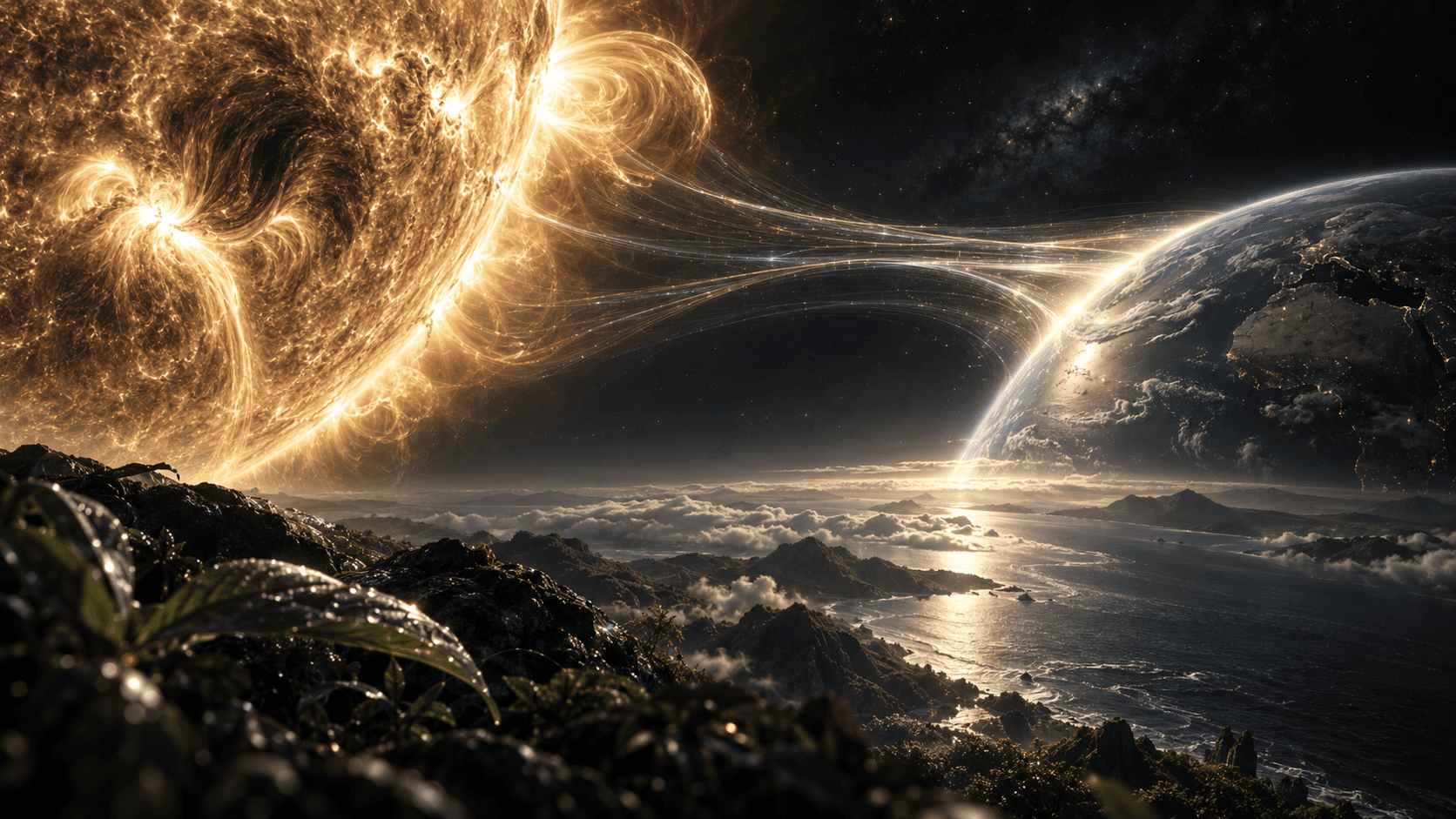
Consider our seemingly extractive Sun. Gathered from a cloud of gas and dust, it draws on a vast inheritance of matter. In its core, hydrogen fuses into helium, releasing energy that eventually radiates into space.[2] Through a human lens, we might imagine a voracious body consuming its reserves, indifferent to everything around it.
A selfish star, burning through its inheritance.
Yet a little over eight minutes after sunlight leaves its surface, some of it reaches Earth.[2] What escapes one system becomes a source of possibility for another. It warms oceans, feeds the chemistry of leaves and passes through the tangled lives of creatures who will never look up and recognise its source.
Zoom out, and our selfish Sun begins to look remarkably altruistic.
The Sun has not changed its character. We have changed the picture. Selfishness and altruism belong to the stories we tell about the relationships through which its effects unfold.
What appears wasteful within one frame can become life giving within another.
This does not make every act of extraction benign. It makes the frame consequential. A process can nourish some relationships while exhausting others, and its effects can change across time and scale. To understand it, we have to follow those relationships beyond the place where we first decided what it meant.
We belong to this same universe. Our brains, technologies and institutions have emerged within it. Even our most elaborate abstractions acquire consequences through bodies, materials, energy and action. We cannot step outside nature’s laws, although we can become extraordinarily adept at overlooking the dependencies through which those laws shape our lives.
Perhaps the more troubling question is how a creature so capable of understanding the world can build systems that become so inattentive to it.
A world of dualisms
When we envision nature, we often summon deep forests, lakes, wild animals and places seemingly untouched by human hands. When we envision culture, we picture cities, commerce, machines and the crowded theatre of human affairs.
Almost without noticing, we draw a line.
On one side lies the world that made us. On the other, the world we have made. Humanity becomes nature’s master, custodian or estranged child. Even our desire to protect it can leave us standing outside the picture.
This distinction has a long and contested history. Within dominant strands of modern Western thought, separations between mind and body, humanity and the rest of life helped make the world appear available for observation and management from outside. The French philosopher René Descartes gave one influential expression to this way of thinking. Industrialisation extended the power to turn forests, rivers, organisms and geological deposits into resources at extraordinary scales.[3,4]
These traditions were never unanimous. Yet particular ways of understanding the world became embedded in institutions powerful enough to organise it.
A distinction made in thought acquired a material life.
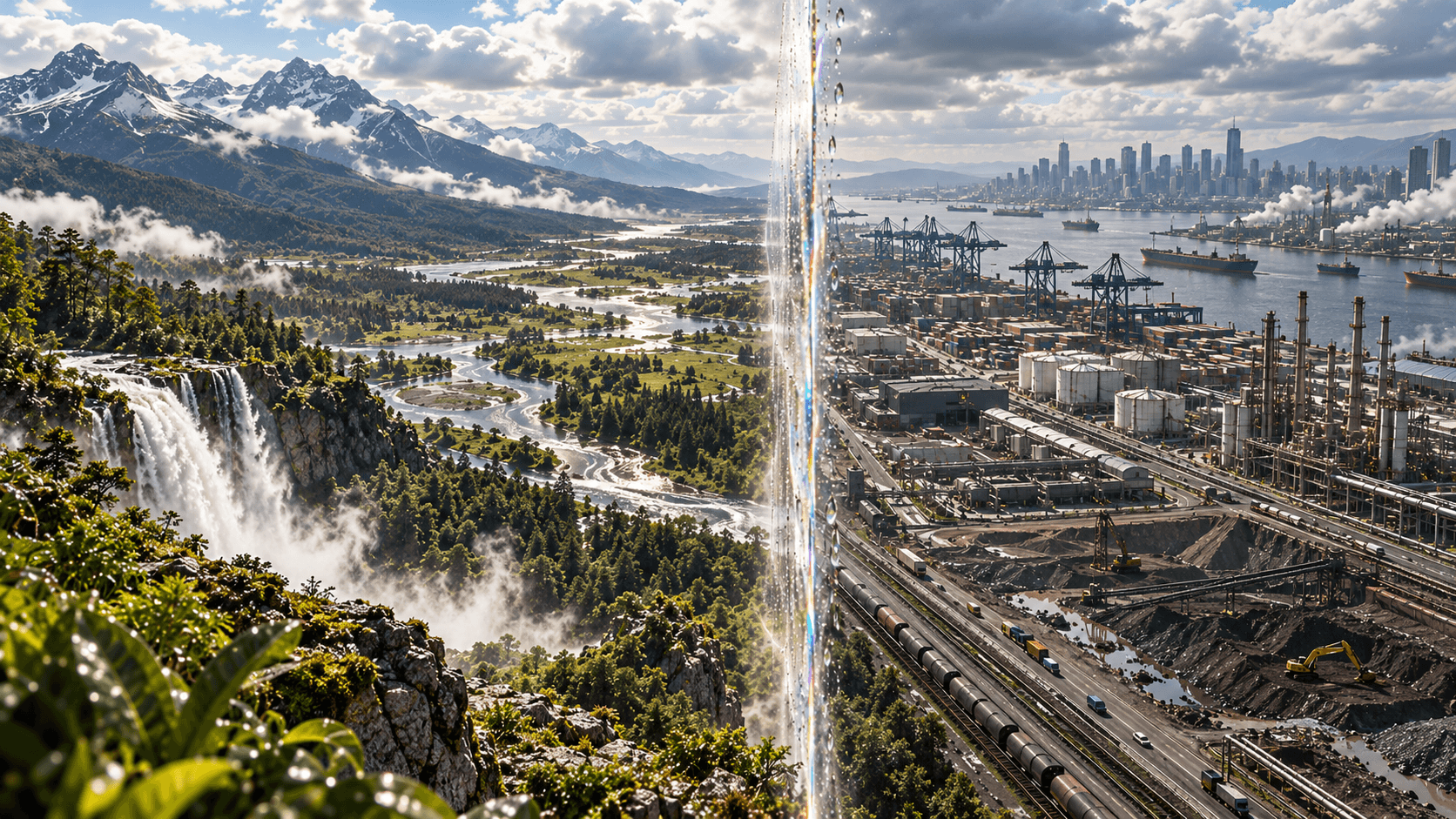
We still live among its consequences. A forest can enter an account as timber while the relationships that keep it alive remain largely absent. A river can appear as a supply of water while the lives, sediments and seasons moving through it become secondary considerations. The description helps determine what can be valued, what can be altered and what can disappear without registering as a loss.
Our systems give material form to what we understand, what we value and what we have learned not to notice.
This is why ecological breakdown reaches so deeply into our ways of knowing. It calls into question the categories through which we organise prosperity, progress, wellbeing and responsibility.
The material causes are real. So are the institutions, incentives and inequalities that sustain them. Beneath and within these arrangements sit assumptions about how the world behaves and what matters within it. Those assumptions help make certain actions appear sensible, necessary or inevitable.
To change our relationship with the world, we must also examine the understanding that our systems continue to enact.
The worlds our stories build
What happens if nature ceases to mean “a thing out there”?
Imagine instead that the word holds the whole physical universe. The place, the source and the unfolding of material phenomena. Humans belong within it, together with our cultures, artefacts and all the consequences of our activities.[3,4]
The city does not leave nature when its first road is laid. A financial market does not float free of the world because its transactions pass through symbols. A story does not become inconsequential because we cannot hold it in our hands.
Our stories move matter. They organise labour, direct attention, establish ownership and decide which futures receive the resources to become real.

Shared stories allow strangers to cooperate across continents and generations. They allow us to imagine something absent, organise around it and bring it into existence.
But they can also become worlds in which we learn to live too comfortably.
A measure of success becomes a destination. A category becomes an identity. An account of the world becomes so familiar that we begin to mistake its boundaries for the boundaries of reality.
We can become exquisitely adapted to our stories while becoming less responsive to the world that sustains them.
A society can grow more accomplished at producing what its institutions reward even as the conditions supporting those accomplishments deteriorate. The story continues to make sense within its own terms. Beyond those terms, rivers change course, soils lose vitality and relationships begin to unravel.
Our intelligence may be working intensely, even brilliantly, within a picture that has become too small.
Learning from the living world
We can begin by falling back in love with the nature within and around us. By allowing it to become our inspiration, our model, our measure and our mentor.[5]
There is more here than a collection of shapes to copy or ingenious mechanisms to borrow. Biomimicry can become a way of questioning how our systems belong within other systems. What do they depend on? What do they make possible? How do they register change, and what happens when the conditions that once supported them begin to shift?
The microbes, critters, plants, animals and systems with whom we share our world carry an immense inheritance of ways to live. Their lives unfold through alliances and rivalries, hunger and abundance, intimate dependencies and unexpected encounters.
A fallen body becomes a gathering place. A leaf borrows light and returns matter to the soil. A creature makes a home, and in doing so alters the possibilities of home for others.
There is violence in this world, and waste, and failure. There are relationships that exhaust themselves and disturbances from which familiar worlds do not return. Yet through these same entanglements, life has continued to find openings.
Nature’s poetry lives in that restless making and remaking.
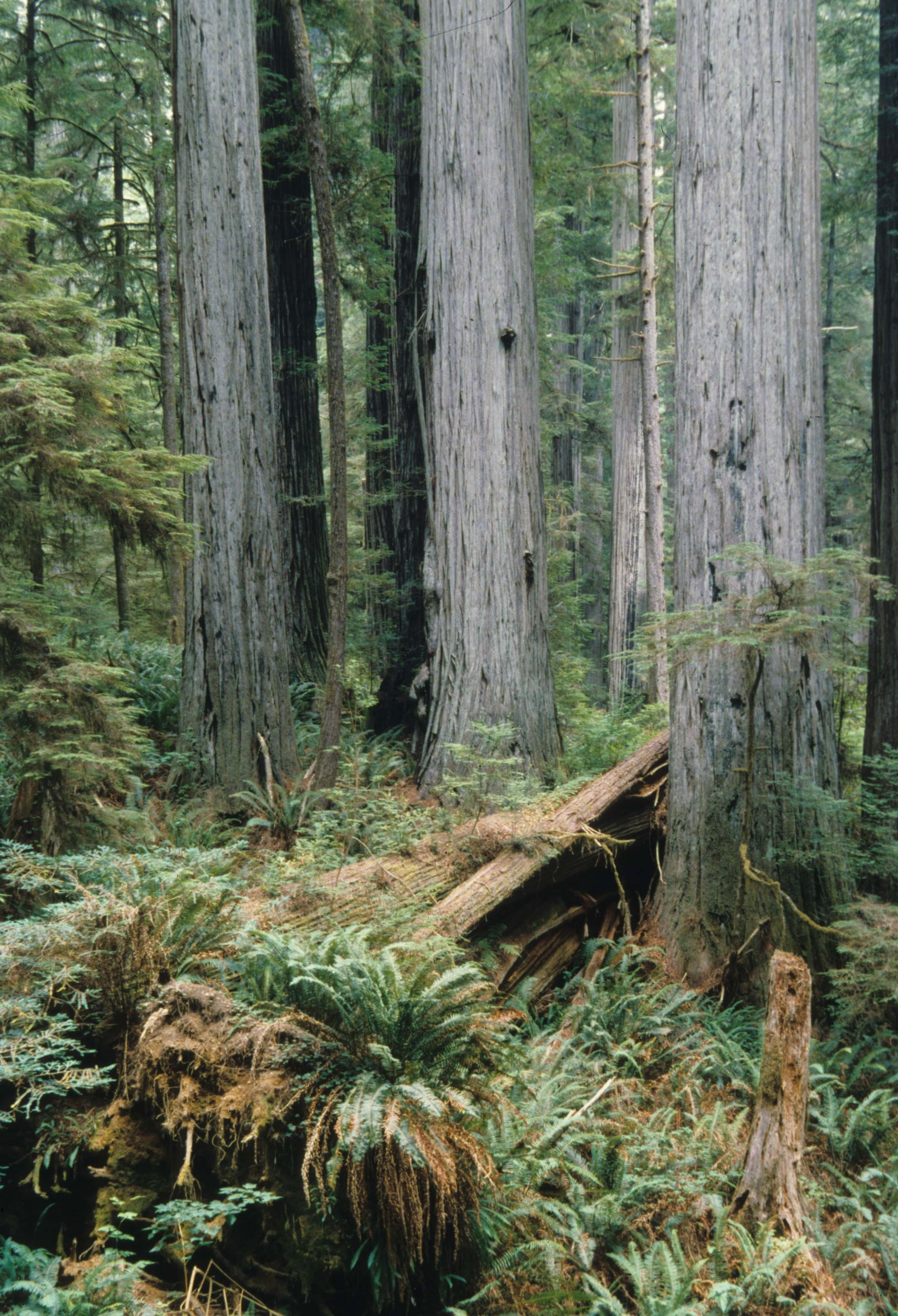
The survival strategy of one organism can become an opportunity for another. What is shed, exhaled or left behind can enter a life its source will never know. Across countless such encounters, the conditions of our own existence took shape.
We are here through an ancient dance that no participant could have choreographed.
To learn from it, we must attend to more than its most beautiful moments. We must ask how relationships endure, how they break and how new possibilities emerge from their rearrangement. We must become curious about the conditions under which a contribution at one scale becomes a cost at another.
The living world offers an extraordinary abundance of teachers. Learning requires us to remain open to what their lives reveal, including what unsettles our preferred story.
What our intelligence inherits
As we learn from the world, we are also building systems that learn from us.
We feed them our language, our records, our classifications and our accounts of what matters. Within that inheritance lie remarkable discoveries, alongside prejudices, omissions and stories repeated so often that they have acquired the appearance of fact.
Artificial intelligence enters a world already thick with interpretation.
A model trained on our descriptions can reproduce their patterns with extraordinary fluency. Yet the frequency with which something is said tells us little, by itself, about how faithfully it describes the world. An absence in the record can remain an absence in the model. A familiar assumption can return with the borrowed authority of a machine.
Research into model collapse offers a particular warning. Under studied conditions, repeatedly training generative models on the outputs of earlier models causes them to lose aspects of the original distribution, including less common examples.[6]
There is a wider possibility here. As generated accounts circulate through our institutions, they may influence what we record, what we expect and what subsequent systems learn. Our descriptions can begin to feed upon themselves.
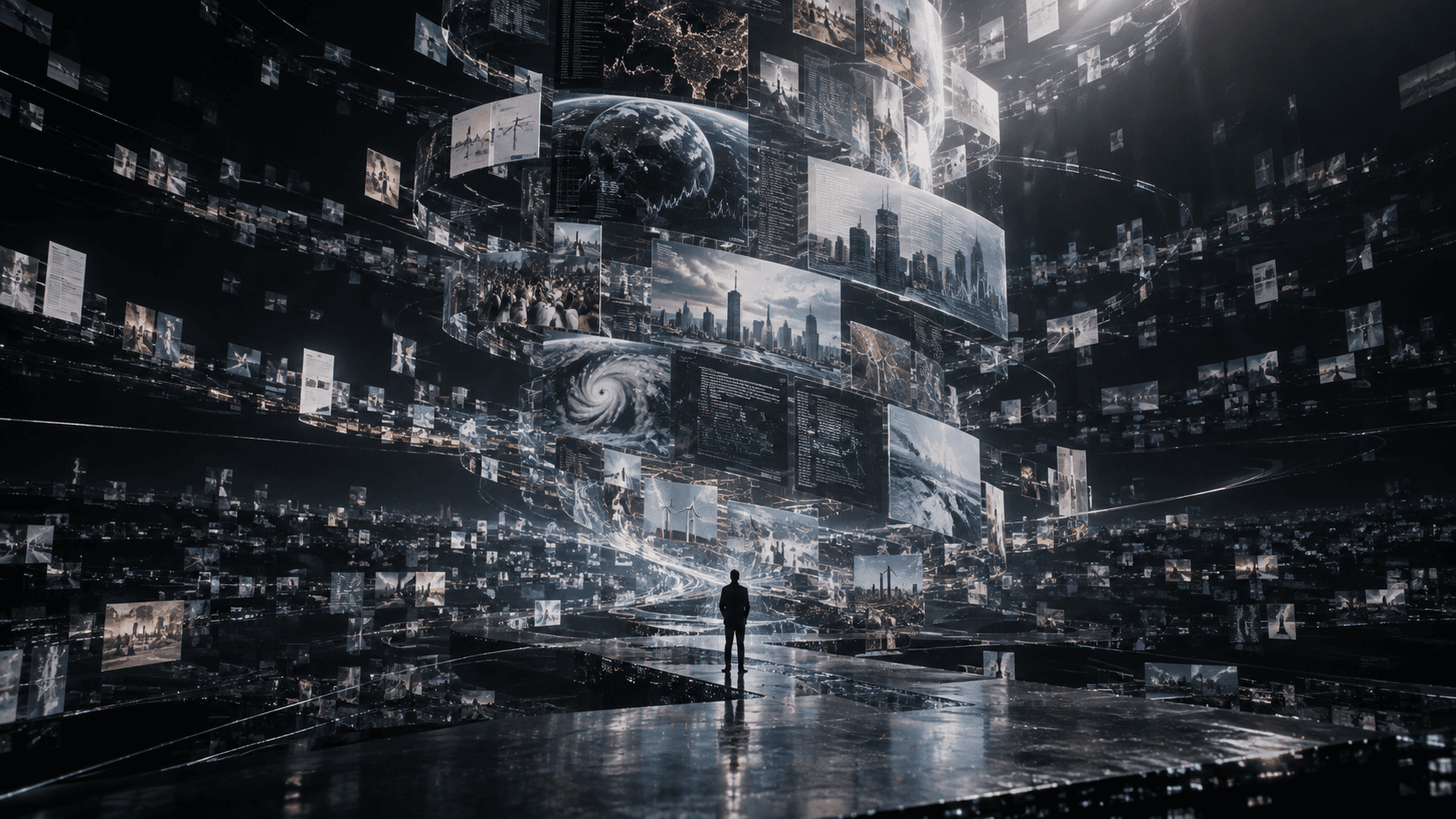
We could build an intelligence that makes our stories more convincing while making us less attentive to what they leave out.
The consequences become more substantial when those systems participate in decisions. An inherited measure of success can become an automated objective. A narrow definition of value can guide resource allocation across thousands of places at once. When the measure excludes the conditions that sustain it, greater capability can accelerate the damage.
An economy could become more efficient at exhausting its own foundations.
This is one possible direction. Artificial intelligence also offers ways to encounter the world that exceed unaided human attention. AlphaFold has advanced protein structure prediction, while GraphCast has demonstrated skilful weather forecasting by learning patterns in atmospheric data.[7,8]
These achievements matter because their predictions can be tested against something beyond the persuasiveness of their language.
We can build systems that help us examine unfamiliar relationships, compare explanations and notice where our expectations fail. AI could help us develop richer, more responsive accounts of the world, bringing neglected dependencies into view and making consequences perceptible before they become irreversible.
But a picture with greater detail can still be organised around the same omission.
The challenge reaches into what an intelligence is taught to attend to, how it encounters evidence and what allows it to revise its account. It reaches into the purposes it serves and the relationships through which its actions return to affect it.
In our own reasoning, the perceptions from which we begin shape the conclusions we can reach. Greater logical power does not automatically repair an inadequate starting picture. This relationship between perception, reasoning and the possibilities of design is central to the conception of biomimetic intelligence.[4]
It becomes more consequential as we give artificial systems a greater part in making the world.
What should our intelligence inherit, and what should it be capable of outgrowing?
The world beyond the story
We are made of the world we are trying to understand. Its matter passes through us. Its histories live in our bodies. Even our most improbable ideas must find their way through its possibilities.
Our belonging reaches beyond what we can presently describe. Quantum entanglement already unsettles the everyday intuition that spatially separated things must possess wholly independent physical descriptions.[9] What such discoveries mean for our broader understanding of relationship remains a question to explore with care. The universe continues to exceed the pictures through which we make it familiar.
The stories are ours. The consequences belong to a much wider and more mysterious world.
We can give those stories room to change. We can invite unfamiliar natural and artificial lives into the picture and allow their presence to alter what seems valuable, possible or true. We can build forms of intelligence that remain answerable to what their accounts leave out.
Our selfish Sun became selfless the moment we followed its light beyond the boundary we originally drew around it. What else might change if we followed the relationships our perceived boundaries conceal?
We are seeking to give our stories unprecedented reach through superintelligence that may venture beyond our home planet.
What happens if the most powerful intelligence we create looks out into the universe and recognises only the echoes of our stories?
This essay expands an earlier article in Biohm’s Contemplations series, written by Dr Ehab Sayed and edited by Marina Ionita.
References
- Smithsonian Institution. Homo sapiens. Human Origins Program. Evidence for the approximate age of our species. ↩
- NASA. Sun: Facts. Solar formation, nuclear fusion and sunlight travel time. ↩
- Ducarme, F. and Couvet, D. (2020). What does “nature” mean? Palgrave Communications, 6, 14. ↩
- Sayed, E. (2022). Biomimetic Intelligence for Systemic Innovation in the Built Environment. PhD thesis, Northumbria University. Particularly pp. 38–40, 54–55, 69–70 and 82–83. ↩
- Sayed (2022), pp. 54–55. Discussion of nature as model, measure and mentor, drawing on Janine Benyus and Henry Dicks. ↩
- Shumailov, I. et al. (2024). AI models collapse when trained on recursively generated data. Nature, 631, 755–759. ↩
- Jumper, J. et al. (2021). Highly accurate protein structure prediction with AlphaFold. Nature, 596, 583–589. ↩
- Lam, R. et al. (2023). Learning skillful medium-range global weather forecasting. Science, 382, 1416–1421. ↩
- Hensen, B. et al. (2015). Loophole-free Bell inequality violation using electron spins separated by 1.3 kilometres. Nature, 526, 682–686. ↩
The Stories We Mistake for Nature
A selfish star sustains a living world. A story becomes a city, an economy, a measure of success. Through the pictures we draw of nature, we organise the world and decide what matters within it. But what happens when we become better adapted to those stories than to the conditions that sustain us? As artificial intelligence inherits our stories and acquires the power to act upon them, it could deepen that estrangement or help us perceive relationships we have barely begun to understand. What should we teach an intelligence that may soon help shape the world beyond our understanding?
A selfish sun
Our cosmos has evolved over approximately 13.8 billion years to host intricate celestial systems, primordial life and, eventually, a species capable of contemplating its own beginnings. Our species, Homo sapiens, emerged around 300,000 years ago.[1] From our brains and relations, entire economic, cultural and social worlds were forged, with intricate patterns and far reaching consequences.
For millennia, we have adapted within nature to survive and thrive. Yet many of the systems we have built now erode the conditions that sustain us. Resource extraction, biodiversity loss and a changing climate are unsettling the world in which our societies took shape.
Modern humanity stands at a peculiar point in its history. We can describe the birth of stars while struggling to understand the consequences of our own growth. But how different are we from the wider world? Are we innately destructive, hosting a proclivity to stifle the possibilities of life around us? How much do our behaviours diverge from those of other natural systems?
Well, compared to some of the earliest systems in the universe, perhaps not so much.
Consider our seemingly extractive Sun. Gathered from a cloud of gas and dust, it draws on a vast inheritance of matter. In its core, hydrogen fuses into helium, releasing energy that eventually radiates into space.[2] Through a human lens, we might imagine a voracious body consuming its reserves, indifferent to everything around it.
A selfish star, burning through its inheritance.
Yet a little over eight minutes after sunlight leaves its surface, some of it reaches Earth.[2] What escapes one system becomes a source of possibility for another. It warms oceans, feeds the chemistry of leaves and passes through the tangled lives of creatures who will never look up and recognise its source.
Zoom out, and our selfish Sun begins to look remarkably altruistic.
The Sun has not changed its character. We have changed the picture. Selfishness and altruism belong to the stories we tell about the relationships through which its effects unfold.
What appears wasteful within one frame can become life giving within another.
This does not make every act of extraction benign. It makes the frame consequential. A process can nourish some relationships while exhausting others, and its effects can change across time and scale. To understand it, we have to follow those relationships beyond the place where we first decided what it meant.
We belong to this same universe. Our brains, technologies and institutions have emerged within it. Even our most elaborate abstractions acquire consequences through bodies, materials, energy and action. We cannot step outside nature’s laws, although we can become extraordinarily adept at overlooking the dependencies through which those laws shape our lives.
Perhaps the more troubling question is how a creature so capable of understanding the world can build systems that become so inattentive to it.
A world of dualisms
When we envision nature, we often summon deep forests, lakes, wild animals and places seemingly untouched by human hands. When we envision culture, we picture cities, commerce, machines and the crowded theatre of human affairs.
Almost without noticing, we draw a line.
On one side lies the world that made us. On the other, the world we have made. Humanity becomes nature’s master, custodian or estranged child. Even our desire to protect it can leave us standing outside the picture.
This distinction has a long and contested history. Within dominant strands of modern Western thought, separations between mind and body, humanity and the rest of life helped make the world appear available for observation and management from outside. The French philosopher René Descartes gave one influential expression to this way of thinking. Industrialisation extended the power to turn forests, rivers, organisms and geological deposits into resources at extraordinary scales.[3,4]
These traditions were never unanimous. Yet particular ways of understanding the world became embedded in institutions powerful enough to organise it.
A distinction made in thought acquired a material life.
We still live among its consequences. A forest can enter an account as timber while the relationships that keep it alive remain largely absent. A river can appear as a supply of water while the lives, sediments and seasons moving through it become secondary considerations. The description helps determine what can be valued, what can be altered and what can disappear without registering as a loss.
Our systems give material form to what we understand, what we value and what we have learned not to notice.
This is why ecological breakdown reaches so deeply into our ways of knowing. It calls into question the categories through which we organise prosperity, progress, wellbeing and responsibility.
The material causes are real. So are the institutions, incentives and inequalities that sustain them. Beneath and within these arrangements sit assumptions about how the world behaves and what matters within it. Those assumptions help make certain actions appear sensible, necessary or inevitable.
To change our relationship with the world, we must also examine the understanding that our systems continue to enact.
The worlds our stories build
What happens if nature ceases to mean “a thing out there”?
Imagine instead that the word holds the whole physical universe. The place, the source and the unfolding of material phenomena. Humans belong within it, together with our cultures, artefacts and all the consequences of our activities.[3,4]
The city does not leave nature when its first road is laid. A financial market does not float free of the world because its transactions pass through symbols. A story does not become inconsequential because we cannot hold it in our hands.
Our stories move matter. They organise labour, direct attention, establish ownership and decide which futures receive the resources to become real.
Shared stories allow strangers to cooperate across continents and generations. They allow us to imagine something absent, organise around it and bring it into existence.
But they can also become worlds in which we learn to live too comfortably.
A measure of success becomes a destination. A category becomes an identity. An account of the world becomes so familiar that we begin to mistake its boundaries for the boundaries of reality.
We can become exquisitely adapted to our stories while becoming less responsive to the world that sustains them.
A society can grow more accomplished at producing what its institutions reward even as the conditions supporting those accomplishments deteriorate. The story continues to make sense within its own terms. Beyond those terms, rivers change course, soils lose vitality and relationships begin to unravel.
Our intelligence may be working intensely, even brilliantly, within a picture that has become too small.
Learning from the living world
We can begin by falling back in love with the nature within and around us. By allowing it to become our inspiration, our model, our measure and our mentor.[5]
There is more here than a collection of shapes to copy or ingenious mechanisms to borrow. Biomimicry can become a way of questioning how our systems belong within other systems. What do they depend on? What do they make possible? How do they register change, and what happens when the conditions that once supported them begin to shift?
The microbes, critters, plants, animals and systems with whom we share our world carry an immense inheritance of ways to live. Their lives unfold through alliances and rivalries, hunger and abundance, intimate dependencies and unexpected encounters.
A fallen body becomes a gathering place. A leaf borrows light and returns matter to the soil. A creature makes a home, and in doing so alters the possibilities of home for others.
There is violence in this world, and waste, and failure. There are relationships that exhaust themselves and disturbances from which familiar worlds do not return. Yet through these same entanglements, life has continued to find openings.
Nature’s poetry lives in that restless making and remaking.
The survival strategy of one organism can become an opportunity for another. What is shed, exhaled or left behind can enter a life its source will never know. Across countless such encounters, the conditions of our own existence took shape.
We are here through an ancient dance that no participant could have choreographed.
To learn from it, we must attend to more than its most beautiful moments. We must ask how relationships endure, how they break and how new possibilities emerge from their rearrangement. We must become curious about the conditions under which a contribution at one scale becomes a cost at another.
The living world offers an extraordinary abundance of teachers. Learning requires us to remain open to what their lives reveal, including what unsettles our preferred story.
What our intelligence inherits
As we learn from the world, we are also building systems that learn from us.
We feed them our language, our records, our classifications and our accounts of what matters. Within that inheritance lie remarkable discoveries, alongside prejudices, omissions and stories repeated so often that they have acquired the appearance of fact.
Artificial intelligence enters a world already thick with interpretation.
A model trained on our descriptions can reproduce their patterns with extraordinary fluency. Yet the frequency with which something is said tells us little, by itself, about how faithfully it describes the world. An absence in the record can remain an absence in the model. A familiar assumption can return with the borrowed authority of a machine.
Research into model collapse offers a particular warning. Under studied conditions, repeatedly training generative models on the outputs of earlier models causes them to lose aspects of the original distribution, including less common examples.[6]
There is a wider possibility here. As generated accounts circulate through our institutions, they may influence what we record, what we expect and what subsequent systems learn. Our descriptions can begin to feed upon themselves.
We could build an intelligence that makes our stories more convincing while making us less attentive to what they leave out.
The consequences become more substantial when those systems participate in decisions. An inherited measure of success can become an automated objective. A narrow definition of value can guide resource allocation across thousands of places at once. When the measure excludes the conditions that sustain it, greater capability can accelerate the damage.
An economy could become more efficient at exhausting its own foundations.
This is one possible direction. Artificial intelligence also offers ways to encounter the world that exceed unaided human attention. AlphaFold has advanced protein structure prediction, while GraphCast has demonstrated skilful weather forecasting by learning patterns in atmospheric data.[7,8]
These achievements matter because their predictions can be tested against something beyond the persuasiveness of their language.
We can build systems that help us examine unfamiliar relationships, compare explanations and notice where our expectations fail. AI could help us develop richer, more responsive accounts of the world, bringing neglected dependencies into view and making consequences perceptible before they become irreversible.
But a picture with greater detail can still be organised around the same omission.
The challenge reaches into what an intelligence is taught to attend to, how it encounters evidence and what allows it to revise its account. It reaches into the purposes it serves and the relationships through which its actions return to affect it.
In our own reasoning, the perceptions from which we begin shape the conclusions we can reach. Greater logical power does not automatically repair an inadequate starting picture. This relationship between perception, reasoning and the possibilities of design is central to the conception of biomimetic intelligence.[4]
It becomes more consequential as we give artificial systems a greater part in making the world.
What should our intelligence inherit, and what should it be capable of outgrowing?
The world beyond the story
We are made of the world we are trying to understand. Its matter passes through us. Its histories live in our bodies. Even our most improbable ideas must find their way through its possibilities.
Our belonging reaches beyond what we can presently describe. Quantum entanglement already unsettles the everyday intuition that spatially separated things must possess wholly independent physical descriptions.[9] What such discoveries mean for our broader understanding of relationship remains a question to explore with care. The universe continues to exceed the pictures through which we make it familiar.
The stories are ours. The consequences belong to a much wider and more mysterious world.
We can give those stories room to change. We can invite unfamiliar natural and artificial lives into the picture and allow their presence to alter what seems valuable, possible or true. We can build forms of intelligence that remain answerable to what their accounts leave out.
Our selfish Sun became selfless the moment we followed its light beyond the boundary we originally drew around it. What else might change if we followed the relationships our perceived boundaries conceal?
We are seeking to give our stories unprecedented reach through superintelligence that may venture beyond our home planet.
What happens if the most powerful intelligence we create looks out into the universe and recognises only the echoes of our stories?
This essay expands an earlier article in Biohm’s Contemplations series, written by Dr Ehab Sayed and edited by Marina Ionita.
References
- Smithsonian Institution. Homo sapiens. Human Origins Program. Evidence for the approximate age of our species. ↩
- NASA. Sun: Facts. Solar formation, nuclear fusion and sunlight travel time. ↩
- Ducarme, F. and Couvet, D. (2020). What does “nature” mean? Palgrave Communications, 6, 14. ↩
- Sayed, E. (2022). Biomimetic Intelligence for Systemic Innovation in the Built Environment. PhD thesis, Northumbria University. Particularly pp. 38–40, 54–55, 69–70 and 82–83. ↩
- Sayed (2022), pp. 54–55. Discussion of nature as model, measure and mentor, drawing on Janine Benyus and Henry Dicks. ↩
- Shumailov, I. et al. (2024). AI models collapse when trained on recursively generated data. Nature, 631, 755–759. ↩
- Jumper, J. et al. (2021). Highly accurate protein structure prediction with AlphaFold. Nature, 596, 583–589. ↩
- Lam, R. et al. (2023). Learning skillful medium-range global weather forecasting. Science, 382, 1416–1421. ↩
- Hensen, B. et al. (2015). Loophole-free Bell inequality violation using electron spins separated by 1.3 kilometres. Nature, 526, 682–686. ↩
